
Key figures for 2025
- Proportion of women: 28,6 %
- Engagement score: 7,9 of 10
- Number of dialogue meetings with affected local communities in connection with the update of area development plans in 2024 and 2025: 14
Targets for people
For our own employees, we have worked systematically with established objectives over time. For workers in the value chain and affected local communities, we have defined new objectives as part of the transition plan.
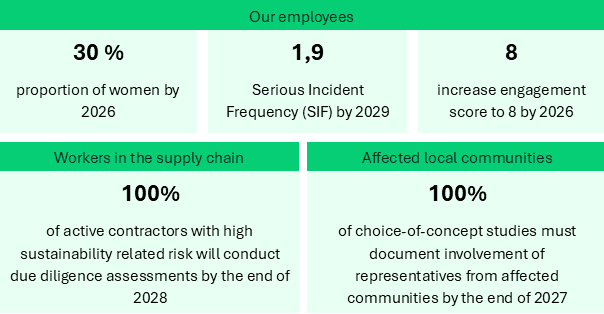
Our employees
- 30 % proportion of women by 2026
- 1,9 Serious Incident Frequency (SIF) by 2029
- Increase engagement score to 8 by 2026
Workers in the supply chain
- 100 % of active contractors with high sustainability related risk will conduct due diligence assessments by the end of 2028
Affected local communities
- 100 % of concept selection studies must document involvement of representatives from affected communities by the end of 2027
How we work to achieve the targets:
To realise our objectives, we have established a comprehensive approach to safeguarding people within our organization, in the value chain and in affected local communities.
Below is an overview of examples of measures that have been implemented or planned to reduce negative impacts and enhance positive outcomes:
Own employees
- Focus on diversity and inclusion in our recruitment processes
- Further develop the safety culture and improve HSE internal control, including risk management an competence management.
- Strengthen the competence of our employees and managers
Workers in the value chain
- Strengthen the data foundation for due diligence assessments
- Systematic and risk-based follow-up of suppliers work on human rights
- Enhance internal competence on due diligence
Affected communities
- Improve and systematise stakeholder dialogue in the early phase
- Cover costs for the reindeer herding community related to participation in meetings
- Strengthen internal competence through reindeer husbandry courses
Our employees
Our employees are the foundation of our business, and their well-being and engagement are crucial to Statnett. Promoting equality, diversity, and inclusion is not only an ethical responsibility but also a strategic advantage.
Statnett strives to create a workplace that values diverse perspectives and fosters respect and inclusion regardless of gender, ethnicity, age, sexual orientation, disability, or other differences. Read Statnett’s statement under §26 of the Equality and Anti-Discrimination Act (in Norwegian) (employer's activity and reporting duty).
Statnett aims to be a safe workplace. We work to prevent all accidents and injuries to personnel, emphasising this particularly because our activities involve high personal risk. We also actively address risks related to human rights and decent working conditions throughout our operations and supply chain.
Workers in the supply chain
The pace of grid development is increasing in Norway and globally to enable the transition to a low‑emission society and meet the growing demand for energy. This results in a challenging supplier market for Statnett, with high demand and global supply chains affecting workers throughout the value chain. The risk of human rights violations and poor working conditions is present in several parts of the supplier chain, including mineral extraction, component manufacturing, the use of foreign labour during grid construction, and safety and working conditions related to construction projects.
In light of our societal mission, our role as a state-owned enterprise, and expectations from stakeholders, Statnett has a particular responsibility to reduce negative impacts and help ensure safe and decent working conditions. We work strategically with our suppliers to support a responsible transition.
Statnett’s ethical guidelines for suppliers outline our expectations and requirements for all partners, business associates, and suppliers, including their employees, board members, hired personnel, and consultants working under a contract with a Statnett supplier. These requirements also apply to any subcontractors.
Affected local communities
The transition to a low‑emission society depends on broad public support, both globally and locally, and especially from those directly affected by new development projects. A rapid transition must therefore also be a responsible one.
When we plan and build, it must be done as gently as possible for the local communities affected by our activities. Statnett must balance considerations for local communities and Indigenous peoples with security of supply and project progress. This brings both risks and opportunities.
Statnett engages relevant stakeholders from affected communities throughout the entire project lifecycle, from early planning to operation.
Statnett aims to find solutions that safeguard the interests of Indigenous peoples and the reindeer husbandry industry, and to ensure that dialogue takes place in accordance with the principle of Free, Prior and Informed Consent (FPIC). We have for a long time worked to maintain regular dialogue and cooperation with the reindeer husbandry industry to account for their interests. This work is followed up on an ongoing basis.
For more information about Statnetts impacts and the measures we implement, see our transition plan and our annual report.